You spend a lot of time trying to hire good people. But what happens after you hire them?
The job changes. Your systems change, new tools come in, and customers expect more. The employee who was perfect for the role two years ago may need a different skill set to keep up today.
The World Economic Forum estimates that 59% of the global workforce will need training by 2030. Professional development is how you get the people you already have ready for what the business needs next.
As Ruffy Galang, our CEO and Co-Founder, puts it:
“Hiring good people is only the start. If you want them to keep getting better, you have to give them opportunities to learn, take on more, and grow with the business.”
 Ruffy GalangCEO of Remote Employee®
The benefits of professional development go well past a certificate on someone’s résumé. Done well, it helps people perform better, stay longer, and take on more as the business grows.
Why Is Professional Development Important?
Think about how much the average job has changed in the last few years.
AI is changing how work gets done, new software keeps arriving, and people end up with duties that were never in their job description.
So, what happens when your business needs a skill your team doesn’t have?
You can go back to the job market every time, or you can help good employees develop some of those skills themselves.
That could be a course, a certification, or time with a mentor, as long as it’s tied to the work they do.
Good professional development at work helps someone do their current job better or get ready for the next one. Either way, their skills keep moving as the business changes.
That’s the importance of professional development: when the business changes, your people’s skills keep pace.
10 Benefits of Professional Development
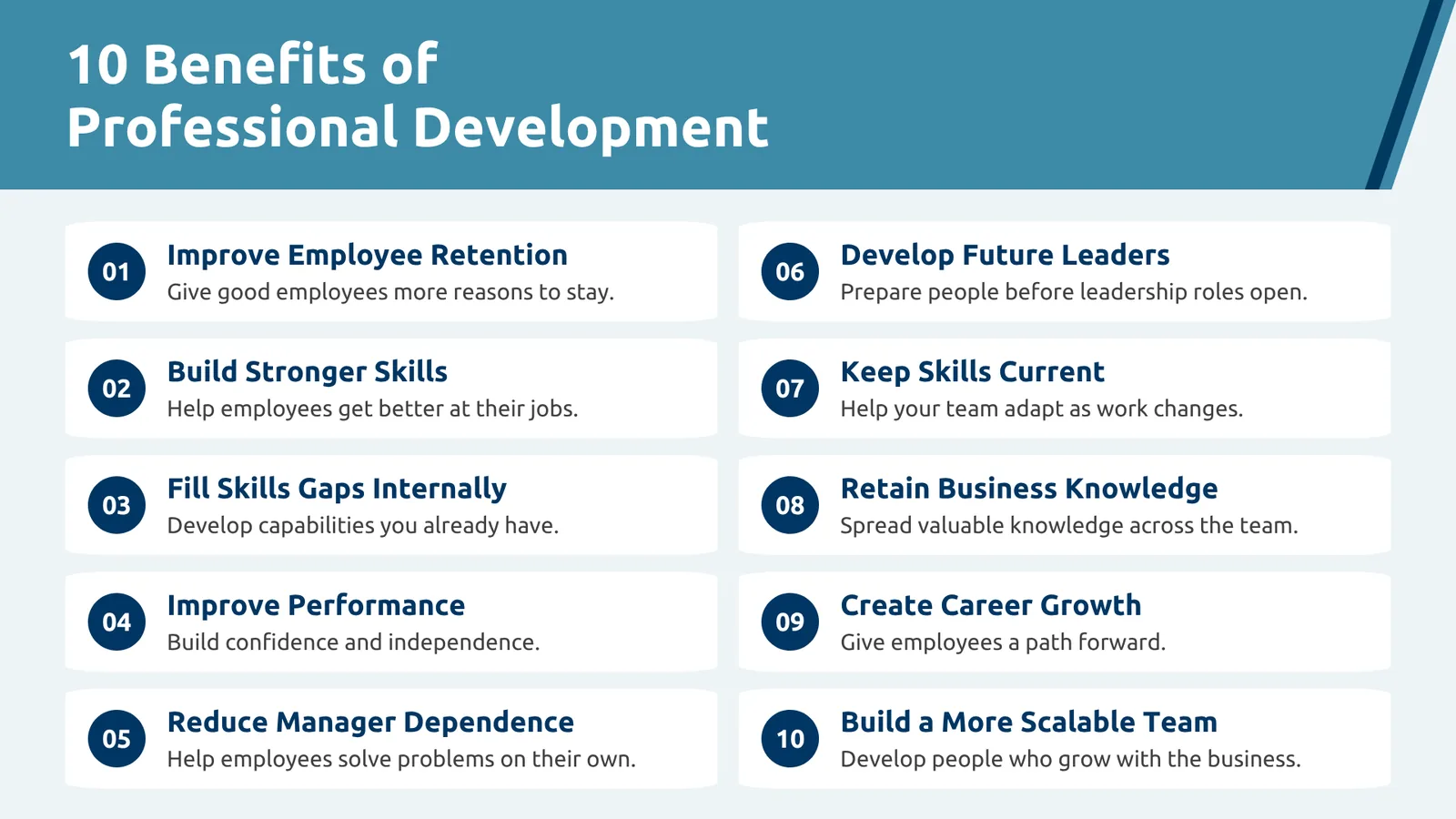
Some professional development benefits show up for the employee first, others for the business. Most end up helping both.
1. You Give Good Employees a Reason to Stay
You find someone good, train them, get them up to speed, and then they leave.
Development gives people a clearer sense of where their career is going, and that helps keep turnover down.
Progress can be as simple as a new certification or the chance to lead a project. When people can see more than one way forward, it’s easier for them to picture their next few years with you.
LinkedIn’s 2025 Workplace Learning Report found that 88% of organizations were concerned about employee retention, with learning opportunities ranked as the No. 1 retention strategy among respondents.
Development won’t fix bad management or low pay. Paired with a decent manager and real room to grow, though, it gives people one more reason to stay, and it belongs in your broader employee retention strategy.
2. Your Employees Get Better at Their Jobs
This is one of the simplest professional development benefits.
A bookkeeper learns a new accounting platform. A customer service representative improves how they handle difficult calls. A salesperson learns how to use the CRM properly.
Better-trained employees tend to make fewer mistakes and solve problems faster, and the more they use what they’ve learned, the more they can handle on their own.
Judge any training by one test: can the person now do some part of their job better?
3. You Don’t Have to Hire for Every New Skill
Not every skills gap needs to become an open position.
Sometimes the person you need is already on your payroll.
Maybe an administrator can learn your new reporting system, or an experienced team member can train for a different responsibility.
That’s one of the biggest benefits of employee development: you build skills inside the business instead of hiring every time the work changes.
Some roles do need someone with experience. Before you open another position, ask:
Can someone we already have learn this?
If the answer is no, a strong talent pool gives you somewhere to look.
4. Professional Development Can Improve Performance
So, how does professional development improve performance?
It helps people get more of their work right without checking in at every step.
Someone who understands the system spends less time figuring it out. Someone with stronger problem-solving skills can handle more without escalating everything to a manager.
Training alone won’t do it. If you’re developing someone for management, give them a real team task to lead. If they’re learning software, put it on live work.
5. Your Managers Don’t Have to Do Everything
If every question still goes to the manager, your team isn’t really scaling.
As people get more capable, they can handle more on their own instead of bringing every unfamiliar problem to their manager.
That gives managers room to manage instead of checking every task.
Oversight stays. What changes is how much hand-holding people need.
6. You Build Your Next Leaders Before You Need Them
Your best employee doesn’t automatically become a great manager.
Leadership requires different skills: delegation, feedback, communication, conflict management, prioritization, and coaching.
Mentoring and leadership training let them learn from people who’ve already done the job they’re working toward.
Give someone a project to lead. Let them mentor one of your new hires. Have them run a meeting before they’re responsible for an entire team.
Start that preparation before a management role opens, so someone is ready when it does.
7. Your Team Can Keep Up When the Work Changes
Your employees won’t use exactly the same tools forever.
AI is already changing research, admin, customer support, and software development, and your people need ways to keep up.
That’s why professional development for employees should keep both technical and soft skills current, through continuing education or hands-on training.
Instead of replacing someone whenever their job changes, you may be able to help a good employee change with it.
That’s an important part of building a future-ready workforce: knowing which capabilities you can develop internally and which ones you need to hire for.
8. You Keep More Knowledge Inside the Business
When an experienced employee leaves, what they know often leaves with them.
Cross-training, mentoring, and job shadowing spread that knowledge around, so more than one person knows how things work.
It also softens the real cost of replacing an employee, because some of what took that person years to learn stays behind.
9. Employees Can See a Future with the Company
People want to know where their work is taking them.
If someone has been doing the same thing for years with no new responsibilities or skills, it shouldn’t be surprising if they start looking around.
That’s one reason why professional development is important in the workplace: it gives people a sense of progress.
One employee may want management. Another wants deeper technical expertise. Someone else wants to learn a different part of the business.
When people can see a path forward, they don’t have to leave to grow.
10. You Build a Team That Can Grow with the Business
As your business grows, the work gets more complicated and people need to take on more.
A well-trained workforce gives you more options.
You can promote from within, develop specialists, move employees into new job roles, and fill some skills gaps internally.
You’ll still hire, but it won’t be your only answer.
What Does Professional Development at Work Look Like?
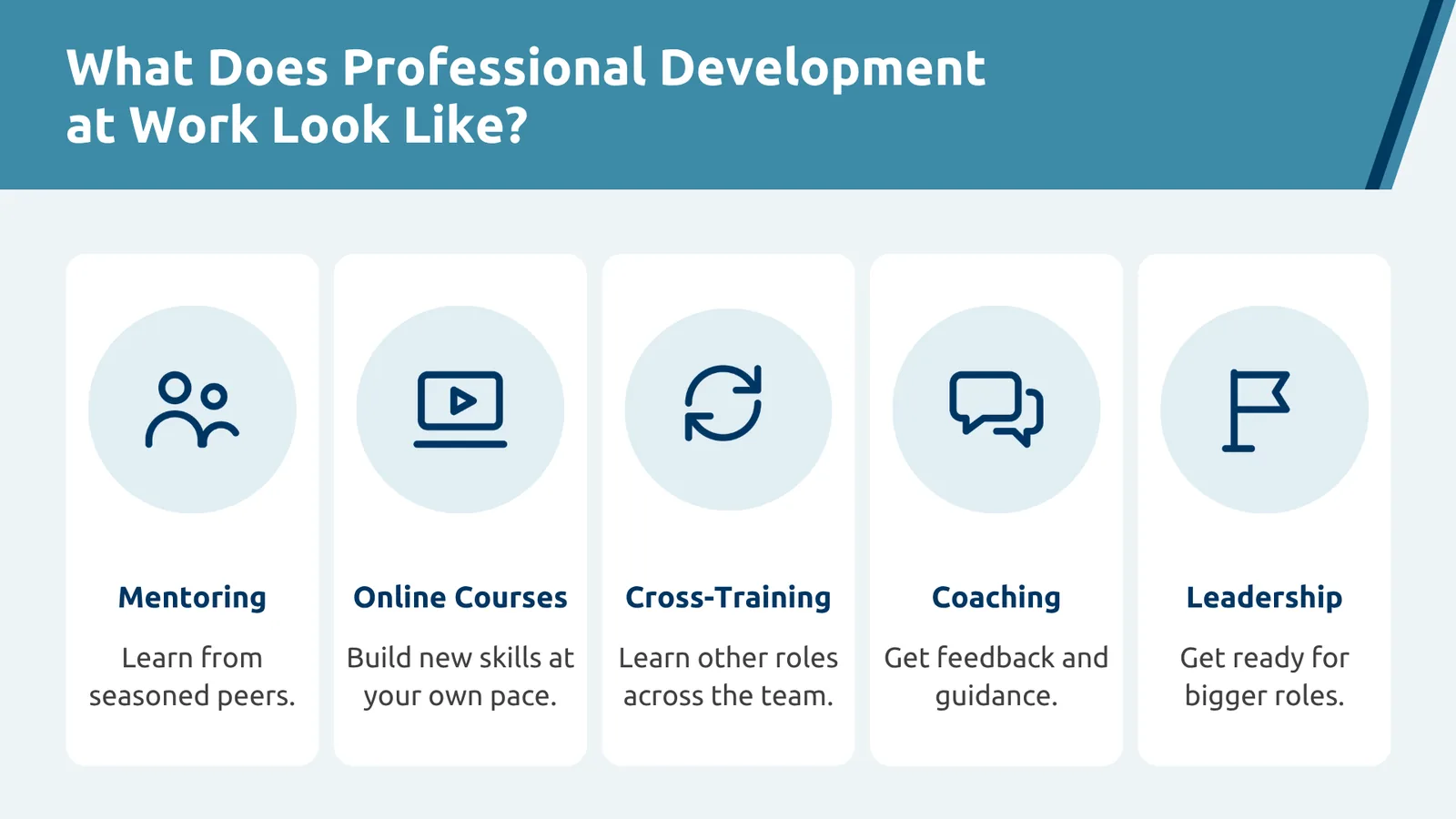
Professional development doesn’t mean sending everybody to conferences.
It can include:
- Online courses
- Certifications and continuing education
- Coaching
- Mentoring
- Cross-training
- Job shadowing
- Leadership training
- In-person workshops
- Stretch assignments
- Networking
- Technical skills training
Remote work opens up more options. People can take courses online and learn from mentors in other locations.
You don’t need to offer all of it. Pick what fits the person, their goals, and the work they do.
How to Make Professional Development for Employees Work
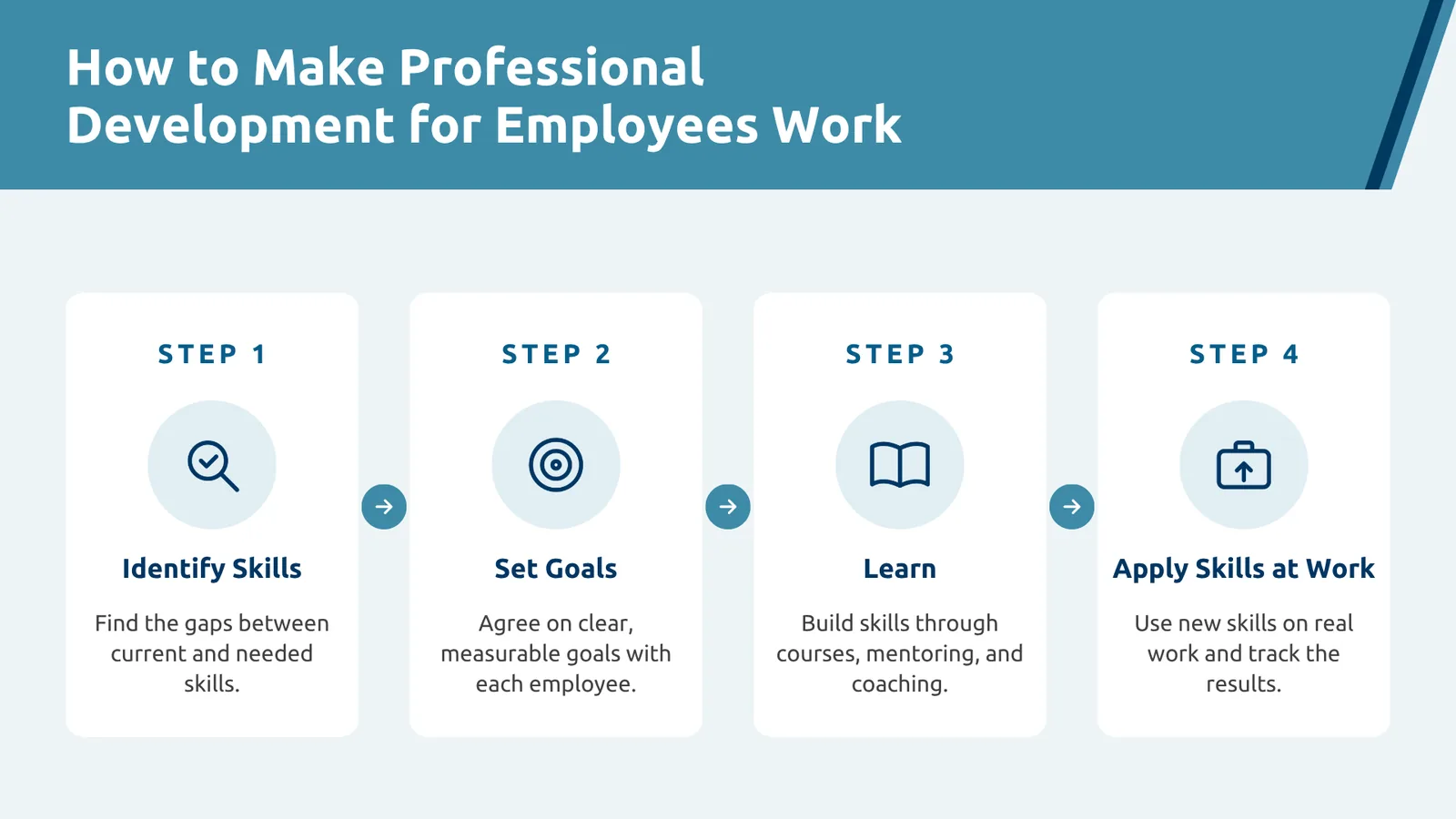
Start with the employee’s actual job.
Don’t ask, “What course should we buy?”
Ask: What does this person need to get better at?
Then make the goal specific and time-bound. “Become a better leader” is vague. “Lead the weekly team meeting on your own within 60 days” gives both of you something concrete to work toward.
Give people time to learn, too. You can’t say professional development matters and then fill every hour of their day. Keep the plan simple as well, since a complicated one eats up the manager’s time along with the employee’s.
Most importantly, let them use what they learn.
Give them a project or a real problem to apply it to, so the learning keeps going after the course ends.
Professional Development vs. Hiring: When to Use Each
You don’t need to choose one or the other.
Sometimes you should develop the person you already have. Sometimes you need someone who already knows how to do the work.
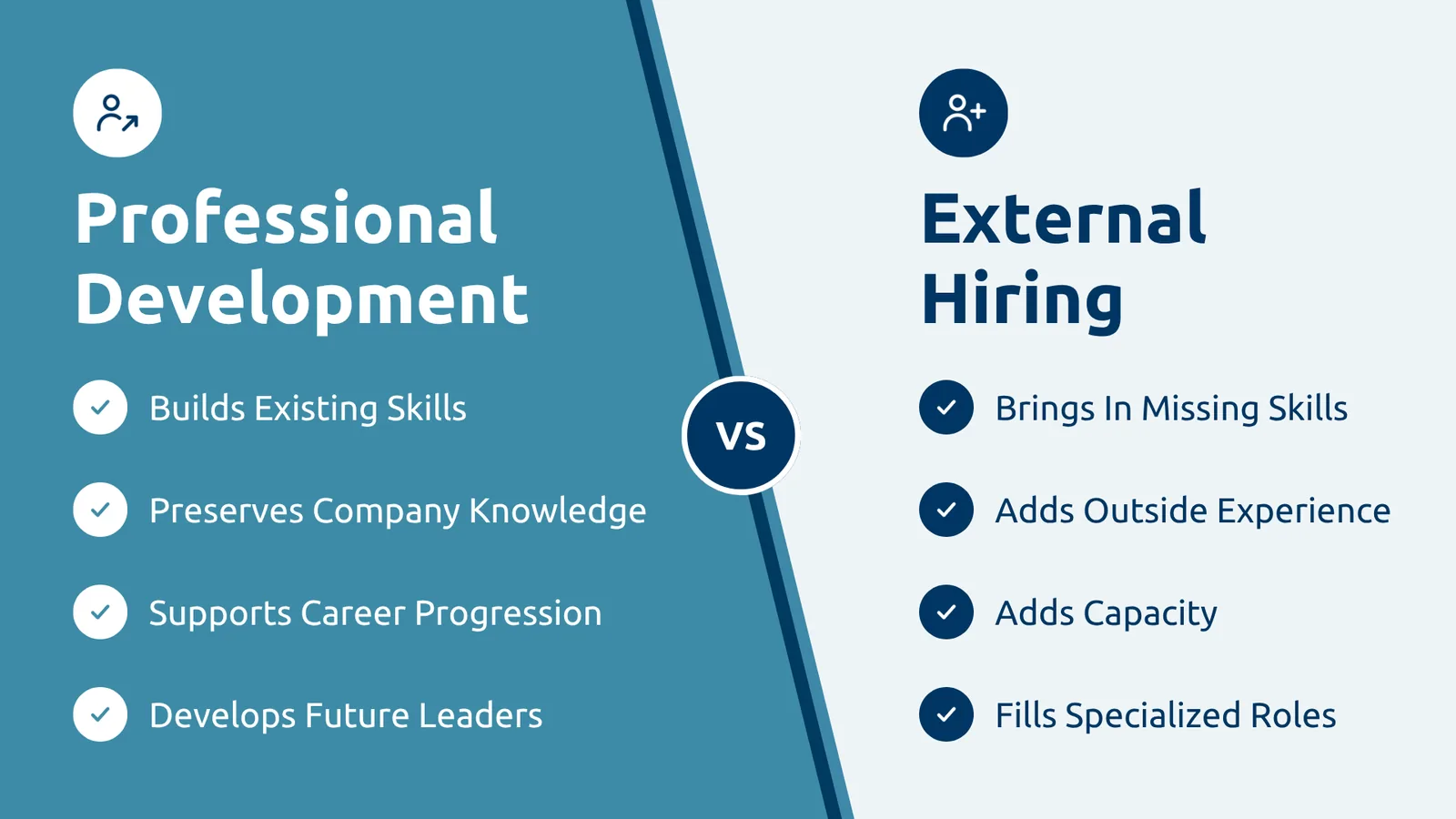
If someone on the team has the potential, develop it. If nobody does, or you need more hands, hire for it. Most growing businesses need both.
Common Questions About the Benefits of Professional Development
What are the benefits of professional development?
Better performance and longer retention top the list. Professional development also builds skills, independence, and future leaders, and it helps your team keep up as the work changes.
How does professional development improve performance?
It gives people the skills their job needs and lets them handle more without help. The gains last when they use what they learn on real work.
Why is professional development important?
Because jobs keep changing. Professional development keeps your people’s skills current, so you can fill more needs from within.
Why is professional development important in the workplace?
It gives employees a reason to stay. People who can learn and take on more at work don’t have to leave to grow, and the business keeps what they know.
Put the Benefits of Professional Development to Work
You don’t need to replace a good employee every time the job changes.
Give good people room to learn and take on more. When you need skills or capacity you don’t have, bring in someone who does.
When that time comes, we find and screen professionals in the Philippines who’ve already done the work you need, then handle their employment, payroll, and benefits. You interview. You choose. We employ.
Hiring for a skill your team doesn’t have yet? Book a 10-minute call with a recruiter.