

| Don’t have the time to read? Listen here instead or save to your Spotify playlist.
 |
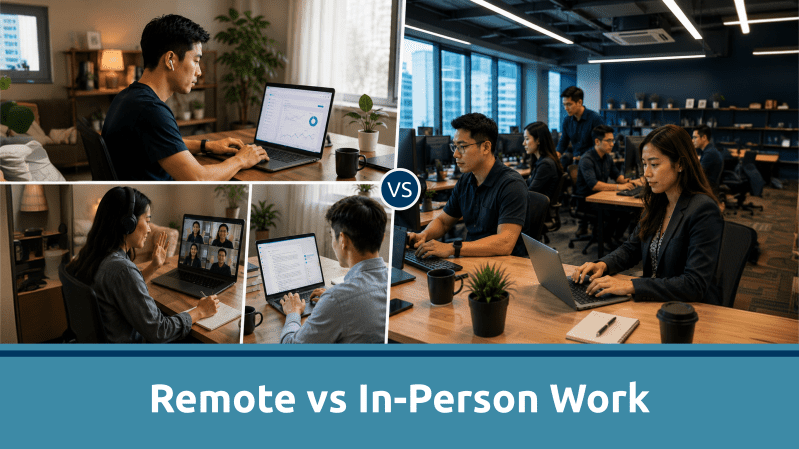
The debate around remote vs in person work is a hotly debated topic — even as the workplace itself has already changed. Some companies are pushing employees back into offices. Others are doubling down on remote teams. Many leaders are stuck in the middle, unsure which model actually delivers better results.
The reality is this: the question isn’t whether remote or in-person work is better in theory. It’s about understanding the pros and cons of each work arrangement and determining which model works better in practice, given today’s talent shortages, rising costs, and pressure to move faster with fewer resources.
In this guide, we’ll break down remote vs in office productivity, leadership impact, costs, collaboration, and long-term performance backed by real research so you can make decisions based on outcomes, not assumptions for your preferred work arrangement.
Remote vs In Office: How Productivity Really Compares

One of the biggest concerns in the “remote vs in office” debate is productivity. Many leaders assume people work harder and productively when they’re visible and working in the office. But the data tells a different story.
A study of 16,000 workers found that remote employees were 13% more productive than their in-office colleagues – all because they had fewer distractions and more focused work time. The study also highlighted that many employees experienced a significant increase in productivity when working remotely.
Gallup State of the Global Workplace 2025 also shows that remote workers with location flexibility report higher engagement and lower burnout, both strong predictors of sustained performance, increased productivity, and improved employee productivity.
Productivity isn’t driven by proximity — it’s driven by clarity, systems, and outcomes, which ultimately leads to better job performance because of these productivity gains.
As Ruffy Galang, CEO of Remote Employee®, explains:
“Most companies don’t have a remote work problem — they have a hiring confidence problem. When leaders know they’ve hired the right people, location stops being a concern.”
Remote Work vs In Person: Focus, Deep Work, and Execution

When comparing remote work vs in person, focus is often overlooked.
Office environments are built around availability, not execution. Constant in person meetings, drop-ins, and interruptions reduce deep work. Microsoft’s Study found that employees now spend 57% of their time communicating, leaving limited time for focused execution.
Offshore teams when managed properly, shift work toward asynchronous collaboration, allowing employees to complete tasks without constant context switching. This enables uninterrupted work and gives employees flexibility, resulting in faster execution with fewer errors.
In Person vs Remote Work: Cost, Flexibility, and Talent Access
From a business perspective, in person vs remote work isn’t just about culture — it’s about economics.
Office-based teams come with:
- Real estate and utilities
- Office space and office equipment costs
- Geographic hiring limits
- Higher wage pressure in competitive cities
Remote teams allow companies to:
- Reduce overhead
- Achieve significant cost savings, including reduced transportation costs for employees
- Hire globally
- Scale faster without fixed costs
Remote work or offshoring comes with benefits – such as access to top talent globally, across many industries. Compared to working in the office full time or several days a week for hybrid set up, remote work flexibility is preferred by many workers who value reduced commuting, lower expenses, and work-life balance. While it’s true that office gives immediate access to resources and equipment, it can also drive-up operational costs and can limit flexibility.
For growing businesses, flexibility isn’t a perk; it’s a competitive advantage.
Remote vs In Person: How Leadership and Management Change
The remote vs in person debate often exposes deeper leadership issues.
In-office environments allow leaders to rely on observation, providing a structured environment that helps align teams with company goals. Remote environments remove that crutch. What replaces it is outcome-based management — or dysfunction.
Organizations now manage teams through various approaches, including the hybrid work model, hybrid model, and remote hybrid arrangements, each requiring different management strategies to ensure productivity and engagement.
Remote work doesn’t weaken leadership. It reveals whether leadership systems actually exist. For fully remote companies and fully remote teams, leadership must adapt to new challenges, while poor management in any setting can negatively impact productivity.
Working in Office vs Remote: Collaboration and Communication
A common belief is that collaboration only works in offices. Working in office vs remote simply changes how collaboration happens. Social interaction and office gossip play a big role in collaboration, team bonding, and keeping employees in the loop about what’s going on in the organization, especially for in-office employees.
Offices rely on real-time interaction, where office workers often have easier access to information and spontaneous collaboration. Remote teams rely on documentation, task ownership, and asynchronous updates. Different working styles and personal needs influence whether employees prefer in-person, fully remote, or remote hybrid collaboration models, as some may value face-to-face interaction while others thrive with flexibility.
In Person vs Remote: Employee Experience, Burnout, and Retention
Remote work has a positive impact on well-being and really supports getting a healthy balance between work and personal life.
And that’s a problem – burnout can lead to people leaving and that can slow growth. But, when done right, remote work can improve retention because it lets employees work at their own pace with more flexibility, which helps maintain work life balance. This has loads of benefits – reduced stress, higher job satisfaction, and improved well-being. Employees feel more recognized and satisfied with their job, making remote work a strong contributor to positive employee experience.
Is Remote Work Better Than in Person for Most Companies?
So, is remote work better than in person?
For most companies, the answer is yes; remote work is better than in person — if the right systems are in place. However, it’s important to consider the potential downsides of remote work, such as communication challenges or feelings of isolation, which can impact team performance if not addressed.
Remote fails when:
- Roles are unclear
- Hiring is rushed
- Accountability is weak
- Workstations are unstructured
- Equipment is unsecured
- Connectivity is unreliable
Remote outperforms when:
- Outcomes are clearly defined
- Talent is properly vetted
- Processes are documented
Remote vs In Person Work: Comparison Table

Why Remote Work Is Better for Companies that Build the Right Systems
When companies design roles around outcomes, remote work is better for companies because it:
- Speeds up hiring
- Lowers costs
- Improves retention
- Forces better leadership discipline
Remote teams don’t succeed by accident; they succeed because systems replace supervision.
Common Questions About Remote vs In Person Work
Learn More About Remote Work, Hiring, and Building High-Performing Teams
Explore these resources to learn how businesses strengthen remote culture, improve hiring strategies, and lead productive teams without micromanagement.
Building Offshore Teams Working in Office vs Remote

When companies compare remote vs in person work, they often frame it as a culture or productivity decision. It’s a system decision and choosing the right work arrangement is critical for success.
In-office teams don’t succeed because people are within reach. Remote teams don’t fail because people are distributed. Performance breaks down when roles are poorly defined, hiring is rushed, and leaders are forced to rely on proximity instead of trust. The right work environment, whether a structured environment in-office or a flexible offshore remote setup, plays a key role in job satisfaction and productivity.
The companies that win aren’t choosing sides in the remote vs in-person debate. They’re building better hiring pipelines, clearer accountability, and access to talent beyond their local market.
And increasingly, they’re realizing that doing all this internally is an immense undertaking — even with the best intentions.
Get the Best of Both Worlds, Without Choosing Between in Person vs Remote
We help companies make remote work — not by outsourcing control, but by removing the uncertainty that forces leaders to micromanage or default back to offices. You work with fully vetted global professionals who are hired for role fit, reliability, and long-term performance — not just available at the time. That means you get remote staff that work in-office but feel remote.
We support fully remote, fully remote companies, hybrid work, remote hybrid, and hybrid model teams, helping you create the optimal work arrangement for your business. Our solutions are designed to improve your work environment and boost job satisfaction for your teams, whether you need a structured environment or maximum flexibility.
Hiring through us gets you the choice of in-person vs remote work because staff hired can work from our Class-A offices or from their own workstations. Through us, businesses have the choice of keeping hires at in office or remote so you get the best of both worlds. We handle the hardest, highest-risk parts of hiring:
- Sourcing from deep global talent pools
- Multi-layered vetting and skills validation
- Compliance, payroll, and HR administration
- Structured onboarding support
So instead of posting jobs, screening hundreds of applicants, and hoping you made the right choice, you interview and select from a curated pool of proven professionals — at up to 70% lower cost than local hiring.
We already do what most companies are trying to build internally:
- Clear role matching
- Outcome-driven hiring
- Stable, long-term team design
The result isn’t just remote teams — it’s teams you don’t need to manage by proximity. Faster hiring. Lower costs. Stronger performance. And leaders who can focus on growth instead of monitoring attendance.
If you’re ready to build an offshore workforce that performs, we help you do it — faster, smarter, and less risky.
Visit RemoteEmployee.com to explore our staffing solutions and build teams that work without the overhead.


